
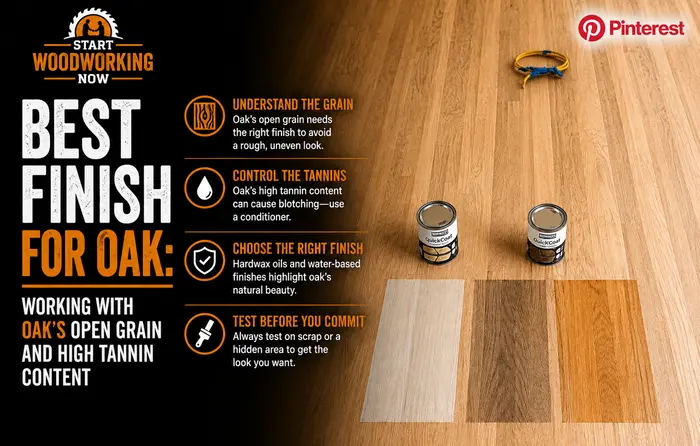
Best Finish for Oak: Working With Oak’s Open Grain and High Tannin Content
This article is part of the wood finishing guide — covering finish selection, application, and the species-specific factors that determine which finish works best on a given wood.
Navigate to your question
→ What makes oak different to finish? → Ring-porous structure and open grain ↓
→ Why does oak react with some finishes and tools? → The tannin factor — staining risk and unique techniques ↓
→ Which finish should I actually use on oak? → Best finishes for oak by goal ↓
→ Should I fill oak’s open grain or leave it textured? → The grain-filling decision ↓
→ What application mistakes are specific to oak? → Oak-specific application specifics ↓
Quick Answer
For most oak furniture, oil-based polyurethane gives the best balance of durability and the warm amber tone that suits oak. For a natural look, use a penetrating oil like tung or danish oil. White oak takes outdoor and wet-area use better than red oak. Avoid steel wool — it reacts with oak’s tannin to leave black stains.
Oak finishes differently from almost any other common furniture wood because of two defining characteristics: its ring-porous structure with very large open pores, and its high tannin content. These two factors drive nearly every oak-specific finishing decision — whether to fill the grain, which finish tone suits the wood, why certain tools and finishes cause staining, and even unique techniques like fuming that are possible specifically because of oak’s chemistry. Understanding these two factors makes oak finish selection straightforward rather than a matter of trial and error.
Quick Decision — Best Finish for Oak by Goal
| Your Goal | Best Choice | Why |
|---|---|---|
| Durable everyday furniture, warm tone | Oil-based polyurethane | Hard film plus amber warmth that complements oak |
| Natural look, easy repair | Tung or danish oil | Penetrates the open grain, keeps a natural matte look |
| Outdoor or wet-area use | White oak + exterior finish | White oak’s tyloses block water; red oak does not |
| Keep the natural pale color, no yellowing | Water-based polyurethane | Stays clear, but seal first to avoid tannin bleed |
| Deep traditional dark tone, no stain | Fuming (ammonia) | Reacts with oak’s own tannin to darken the wood itself |
What Makes Oak Different to Finish — The Wood Structure
Oak is a ring-porous hardwood, meaning its growth rings contain a distinct band of very large pores (the earlywood, formed in spring) alternating with denser, smaller-pored latewood. This structure gives oak its characteristic strong, prominent grain pattern, and makes it one of the most open-grained of all common furniture woods — the large earlywood pores are clearly visible and even feel like texture under a fingertip on an unfilled oak surface. This ring-porous structure is the key contrast with diffuse-porous species like walnut, covered in the best finish for walnut guide, where small, evenly distributed pores make the same grain-filling decision far less consequential.
Why Open Grain Drives the First Finishing Decision
The practical consequence of this open pore structure is that oak presents a fill-or-leave decision that woods with finer, more uniform grain don’t force. A film-forming finish applied directly over unfilled oak will partially sink into those large open pores, leaving a surface that follows the open-grain texture rather than building to a perfectly smooth, level film — which may be exactly the look you want, or may be precisely what you’re trying to avoid, depending on the project. This connects directly to how film-forming finishes behave over porous surfaces, covered in the film-forming vs penetrating finishes guide covering how finishes bridge or fill wood pores.
Red Oak vs White Oak — A Functional, Not Just Visual, Difference
The two common oak types differ in a way that matters for finishing well beyond their slight color difference. White oak’s pores are largely blocked by tyloses — microscopic balloon-like growths that fill the pore cavities — which makes white oak substantially more water-resistant and far less permeable than red oak, whose pores remain open. This is the reason white oak is traditionally used for whiskey barrels, boatbuilding, and outdoor furniture while red oak is not: red oak’s open pores can actually wick water along their length (a straw-like capillary action), making it a poor choice for wet or outdoor applications regardless of finish. For any oak project that will see moisture, confirming whether the wood is white or red oak is a more consequential decision than the finish choice itself.
The Tannin Factor — Oak’s Defining Finishing Challenge
Oak has a high content of tannins — specifically hydrolysable ellagitannins — naturally present in the wood. This tannin content is responsible for several oak-specific finishing behaviours, both problematic and useful, that don’t apply to low-tannin woods.
The Iron Reaction — Why No Steel Wool on Oak
Oak’s tannins react chemically with iron to form iron tannate, a blue-black or grey-black compound — the same reaction historically used to make iron gall ink. In practical finishing terms, this means any iron contamination on oak can cause black or grey staining: steel wool fragments left in the grain, a steel scraper or tool leaving traces, even water with high iron content. This is why steel wool should never be used on oak (and on other tannin-rich woods), since the tiny steel fibres it inevitably leaves behind react with the tannin to produce black spots and streaks once moisture is introduced. Bronze wool or synthetic abrasive pads are the correct substitutes for any oak work where steel wool would otherwise be reached for. This iron-tannin reaction is covered as a distinct phenomenon, separate from tannin bleed, in the tannin bleed guide covering both the bleed mechanism and the iron reaction.
Tannin Bleed Under Water-Based Finishes
Oak’s high tannin content also makes it one of the woods most prone to tannin bleed — brown or yellowish discoloration that appears when water-based finishes or alkaline products dissolve and mobilise the tannins, carrying them into the finish film. This is why a sealing coat — typically dewaxed shellac — is recommended under water-based finishes on oak specifically, to lock the tannins in place before the water-based product is applied. The full mechanism and the sealing solution are covered in the tannin bleed guide linked above; the practical takeaway for oak is that water-based finishes need a sealer coat first, while oil-based finishes generally don’t, since they don’t dissolve the water-soluble tannins.
Fuming — A Technique Oak’s Tannin Makes Possible
The same tannin content that creates staining risks also enables a unique darkening technique: fuming. Exposing oak to ammonia vapour in a sealed enclosure causes the ammonia to react with the wood’s tannins, darkening the wood throughout to a deep brown without any stain or dye — the color change comes from a chemical reaction within the wood itself rather than a pigment applied on top. This is the technique behind much classic Arts and Crafts and Mission furniture (Stickley’s characteristic deep brown oak), and it’s possible specifically because oak’s high tannin content gives the ammonia enough to react with. Lower-tannin woods can’t be fumed to the same effect. Fuming is an advanced technique requiring careful safety precautions around ammonia vapour, but it illustrates how oak’s defining chemical characteristic is both a challenge and an opportunity depending on how it’s approached.
Best Finishes for Oak by Goal
With oak’s structure and tannin understood, the finish choice follows from what you want the finished piece to be — there’s no single “best” finish, but there are clearly better choices for each specific goal, as summarised in the decision table above and explained here.
Oil-Based Polyurethane — The Durable Default
For oak furniture that will see everyday use, oil-based polyurethane is the most common choice for good reason: it builds a hard, durable protective film, and its natural amber tone complements oak’s warm coloring rather than fighting it. The amber warmth that would be a drawback on a wood you wanted to keep pale is generally an asset on oak, deepening the traditional oak look. Application follows standard polyurethane technique, covered in the polyurethane application guide, with the oak-specific addition of the grain-filling decision covered below.
Penetrating Oils — Tung and Danish Oil for a Natural Look
For a natural, low-build look that emphasises oak’s grain and texture rather than building a film over it, a penetrating oil like tung oil or danish oil works with oak’s open structure rather than against it — the oil penetrates readily into the open pores, and the result keeps the tactile grain texture and matte natural appearance many people prefer on oak specifically. Tung oil’s properties and application are covered in the tung oil guide. Penetrating oils don’t dissolve oak’s tannins the way water-based finishes do, so they avoid the tannin bleed concern entirely, though they offer less surface protection than a film finish.
Water-Based Polyurethane — When You Want to Keep Oak Pale
If the goal is to preserve oak’s natural, paler color without the amber deepening that oil-based finishes add — a more contemporary look than traditional warm oak — water-based polyurethane stays clear and non-yellowing. The trade-off is the tannin bleed risk: water-based finishes on oak need a dewaxed shellac sealer coat first, adding a step that oil-based finishes skip. Whether that extra step is worth it depends on how much the pale, clear look matters for the specific project.
Exterior Finishes — White Oak Only
For outdoor oak, the wood choice matters more than the finish: white oak’s tyloses-blocked pores make it suitable for exterior use with an appropriate exterior-rated finish, while red oak’s open pores make it a poor outdoor choice regardless of finish, since water can penetrate along the open pores faster than most finishes can keep it out at edges and end grain. Given white oak, a spar urethane or other exterior-rated, UV-resistant finish designed for outdoor wood movement is the appropriate choice.
Grain Filling — Open Pores and the Smooth-vs-Textured Choice
Oak’s large open pores create a genuine aesthetic decision with no single right answer, only a choice that should be made deliberately rather than by default.
Leaving the Grain Open (Textured)
Applying finish directly over oak without filling the pores preserves oak’s characteristic open-grain texture — the surface follows the natural pore structure, with the finish sitting in and around the pores rather than bridging over them into a glassy-smooth plane. This is the traditional look for much oak furniture, emphasises the wood’s natural character, and requires no extra step. It’s the default unless a smooth surface is specifically wanted.
Filling the Grain (Smooth)
For a perfectly smooth, level, glass-like surface — the look of a high-end tabletop or a more formal, contemporary finish — the open pores need to be filled with grain filler (paste filler) before the finish coats. Grain filler is worked into the pores, the excess scraped off, allowed to dry, and sanded level, creating a flat base for the finish to build a smooth film over. This is a meaningful extra step requiring its own technique, but it’s the only way to achieve a truly smooth surface on open-grained oak, since finish alone will always follow the pore texture to some degree. Grain filler is available in natural (clear or wood-toned) and contrasting colors — a contrasting filler deliberately emphasises the grain pattern by darkening the pores, while a matching filler makes the surface uniform.
Application Specifics and Common Oak Mistakes
Using Steel Wool
As covered above, steel wool on oak risks black iron-tannin staining from steel fragments left in the open grain. This is the single most oak-specific application mistake, and the fix is simply substituting bronze wool or a synthetic abrasive pad. It’s worth checking that any abrasive pads used between finish coats are genuinely synthetic and not steel-based, since the open grain readily traps fragments that finer-grained woods would not.
Skipping the Sealer Under Water-Based Finish
Applying water-based finish directly over bare oak without a sealer coat invites tannin bleed — brown discoloration appearing in the finish as it dissolves and lifts the tannins. The dewaxed shellac sealer step is specific to tannin-rich woods like oak and isn’t needed on low-tannin woods, so it’s a commonly skipped step by those used to finishing other species. On oak, with a water-based topcoat, it’s not optional.
Expecting Finish Alone to Smooth the Grain
Applying coat after coat of finish hoping to build up enough to level oak’s open pores into a smooth surface wastes finish and rarely fully succeeds — the pores are large enough that finish tends to follow the texture rather than bridge it, even with many coats. If a smooth surface is the goal, grain filler is the correct and far more efficient solution than additional finish coats, as covered in the grain-filling section above.
Ignoring the White-vs-Red Oak Distinction for Wet Applications
Using red oak for a project that will see moisture — an outdoor piece, a bathroom vanity, a kitchen surface near a sink — and relying on finish alone to keep water out underestimates how readily red oak’s open pores wick water once finish is breached at any edge or wear point. For genuinely wet applications, choosing white oak from the start is the more reliable approach than trying to fully waterproof red oak with finish.
Frequently Asked Questions
What is the best finish for an oak table?
For an oak dining or coffee table that needs durability, oil-based polyurethane is the most common choice — it builds a hard protective film and its amber tone suits oak’s warmth. For a more natural look with easier repairs, a penetrating oil like tung or danish oil works with oak’s open grain, though it offers less surface protection. If you want to keep oak pale rather than amber, use water-based polyurethane over a dewaxed shellac sealer.
Why does my oak have black stains after sanding?
Black or grey stains on oak are almost always the iron-tannin reaction — steel fragments (usually from steel wool, but sometimes from steel tools or even iron-rich water) reacting with oak’s natural tannins to form a black compound once moisture is present. Avoid steel wool entirely on oak, use bronze wool or synthetic pads instead, and the staining won’t occur. Existing iron stains can sometimes be removed with oxalic acid, which reverses the reaction.
Do I need to fill the grain on oak before finishing?
Only if you want a perfectly smooth, glass-like surface. Oak’s large open pores mean finish alone will follow the grain texture rather than level into a smooth plane. Leaving the grain open is the traditional oak look and requires no extra step; filling the grain with paste filler before finishing is the only way to get a truly smooth surface. It’s a deliberate aesthetic choice, not a requirement.
Is white oak or red oak better for outdoor projects?
White oak, by a wide margin. White oak’s pores are blocked by tyloses, making it far more water-resistant — it’s the traditional choice for boatbuilding and outdoor furniture. Red oak’s pores stay open and can wick water along their length, making it a poor outdoor choice regardless of how it’s finished. For any oak project exposed to moisture, choosing white oak matters more than the finish you put on it.