
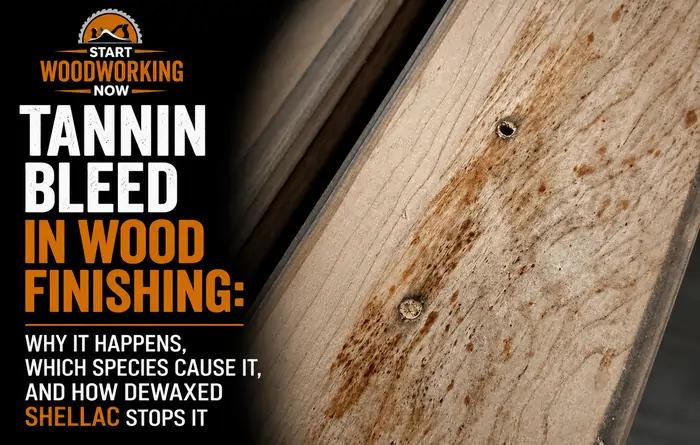
Tannin Bleed in Wood Finishing: Why It Happens, Which Species Cause It, and How Dewaxed Shellac Stops It
Tannin bleed is brown or yellow-brown staining that appears in the first coat of water-based finish on tannin-rich wood species — and it is one of the most commonly misdiagnosed finishing problems because it is often attributed to the wrong cause. It is not caused by a defective finish, incorrect application technique, or contaminated wood. It is caused by the interaction between the aqueous chemistry of water-based finish and the water-soluble polyphenolic compounds present naturally in the wood. Understanding the mechanism — specifically why water dissolves tannins and mineral spirits does not — makes prevention straightforward and the solution obvious.
This article is part of the wood finish curing guide — covering cure mechanisms, polymer types, yellowing chemistry, film formation, and finish behaviour in service.
Navigate to your question
→ What is tannin bleed and what does it look like? → Brown staining in water-based finish — and what tannins actually are ↓
→ Which wood species cause tannin bleed? → Oak, cherry, walnut, cedar — and why some bleed more than others ↓
→ Why does tannin bleed happen — the actual mechanism? → pH-driven dissolution, water-solubility, and why oil-based finishes don’t bleed ↓
→ How do I prevent tannin bleed? → Dewaxed shellac sealer — why it works beyond just physical blocking ↓
→ Is my problem tannin bleed, iron staining, or something else? → Differential diagnosis — colour, pattern, and species as diagnostic tools ↓
What Is Tannin Bleed?
Tannin bleed is the migration of naturally occurring polyphenolic compounds (tannins) from the wood substrate into the wet film of a water-based finish, followed by their concentration at the film surface as the water carrier evaporates. The result is a brown, yellow-brown, or rust-coloured discolouration in the cured finish film — typically most pronounced in the first coat and progressively less visible in subsequent coats applied to the same surface.
Tannins are high-molecular-weight polyphenolic compounds produced by trees as secondary metabolites — part of the wood’s natural defence chemistry against fungal attack, insect damage, and UV degradation. They are concentrated in the heartwood of species that produce them in significant quantities, in ray tissue, and in the wood surface layer most accessible to finishing products. Their biological function — chemical defence — is achieved partly through their ability to react with and precipitate proteins: the same reactivity that makes tannins effective as wood preservatives also makes them reactive with some finish chemistries.
Which Wood Species Cause Tannin Bleed
Not all species produce tannin bleed in equal amounts — the degree of bleed depends on tannin concentration, tannin type, and how accessible the tannins are to the aqueous finish chemistry.
Hydrolysable vs Condensed Tannins — Why Chemistry Matters
Tannins fall into two major chemical classes with different migration behaviour in wood finishing.
Hydrolysable tannins — found in oak, chestnut, and myrobalan — are esters of gallic acid or ellagic acid with glucose or quinic acid. The ester bond between the gallic/ellagic acid and the sugar core is hydrolysable by water and by dilute acid or alkali. In the context of wood finishing, this means hydrolysable tannins dissolve readily in the aqueous phase of water-based finishes and migrate efficiently toward the film surface. Oak ellagitannins — the dominant tannin class in red and white oak — are particularly soluble in mildly alkaline conditions and produce the most visible bleed of any common hardwood species.
Condensed tannins — found in pine, Douglas fir, acacia, and some tropical hardwoods — are polymers of catechin and epicatechin flavonoid units linked by C-C bonds. These C-C bonds are not hydrolysable under normal water conditions, making condensed tannins less water-mobile than hydrolysable tannins. Softwood species with condensed tannins can still produce bleed with water-based finishes, but the staining is typically less severe than oak ellagitannin bleed.
| Species | Tannin / Extractive Type | Bleed Risk | Stain Colour |
|---|---|---|---|
| White oak / Red oak | Ellagitannins (hydrolysable) | HIGHEST | Yellow-brown to amber |
| Cherry | Tannins + cyanogenic glycosides | HIGH | Pink-brown; can deepen to rust |
| Walnut | Juglone + tannins | HIGH | Dark brown; juglone produces deep staining |
| Western red cedar | Thujaplicins + tannins | MODERATE–HIGH | Reddish-brown |
| Redwood | Water-soluble extractives | MODERATE | Red-brown |
| Mahogany | Condensed tannins | MODERATE | Brown |
| Douglas fir | Condensed tannins | Low–moderate | Pale yellow-brown |
| Maple / Birch / Ash | Low tannin content | LOW | Rarely visible |
Walnut and Juglone — Not Technically a Tannin
Walnut deserves specific mention because its water-soluble extractive juglone (5-hydroxy-1,4-naphthoquinone) behaves like a tannin in finishing contexts but is chemically distinct. Juglone is the allelopathic compound that makes walnut toxic to many plants in its root zone. In wood finishing, juglone is water-soluble, migrates readily in the aqueous phase of water-based finishes, and produces dark brown staining at the film surface — visually indistinguishable from ellagitannin bleed but from a different compound. The prevention protocol is identical: dewaxed shellac sealer before water-based topcoats.
How Tannin Bleed Happens — The pH-Driven Mechanism
The mechanism behind tannin bleed explains two critical observations simultaneously: why water-based finishes cause bleed and oil-based finishes do not, and why the bleed is most severe in the first coat and progressively less visible in subsequent coats.
Water Solubility — Why Oil-Based Finishes Don’t Bleed
Tannins are polar, hydrophilic molecules — they are water-soluble and soluble in polar organic solvents, but not soluble in non-polar solvents like mineral spirits or VM&P naphtha. This solubility difference is the complete explanation for why oil-based polyurethane and alkyd varnish do not produce tannin bleed: the non-polar solvent carrier of oil-based finishes cannot dissolve and mobilise the tannins in the wood surface. The tannins remain immobile in the wood substrate, and no migration into the finish film occurs.
Water-based finishes use water as the primary carrier — a highly polar solvent that readily dissolves the hydrophilic tannin molecules from the wood surface on contact. As the liquid finish is applied and penetrates the surface wood cells, the water phase contacts tannin deposits and dissolves them into solution. The dissolved tannins are now mobile in the aqueous carrier.
The pH Amplification Effect
Most water-based finishes are formulated at mildly alkaline pH — typically 8–9 — to ensure emulsion stability and improve coalescence chemistry. Wood tannins are acidic phenols with pKa values of approximately 4–6 — well into the acid range. When alkaline finish water contacts acidic wood tannins, the alkaline environment ionises the tannin phenol groups, increasing their solubility dramatically over what neutral water alone would produce. The pH differential between the alkaline finish water (pH 8-9) and the acidic tannin compounds (pH 4-5) drives faster and more complete dissolution than would occur under neutral conditions.
As the water evaporates during cure, the dissolved tannins become progressively concentrated in the shrinking water phase. The tannins concentrate at the film surface, where evaporation is fastest — producing the characteristic surface discolouration visible as the first coat dries. If the tannin concentration is high enough, the stain is visible through subsequent coats.
Why the Second Coat Bleeds Less
The first coat of water-based finish contacts the bare wood surface and mobilises the most accessible tannin deposits — those in the uppermost cell layers and in ray tissue at the surface. After the first coat cures, most of the surface-accessible tannins have already migrated into and concentrated on the first coat film surface.
The second coat contacts the cured first coat, not bare wood, and encounters significantly lower tannin concentrations — the first coat has acted as a collector and concentrator of the available tannins. This is why bleed is worst in the first coat and diminishes in subsequent coats, and why some finishers incorrectly believe the problem has “fixed itself” by the third coat when it has simply run out of accessible tannin supply.
How to Prevent Tannin Bleed
Prevention requires physically and chemically isolating the water-based finish from the wood surface tannins before the aqueous carrier can dissolve and mobilise them. Two approaches work; one is clearly superior.
Dewaxed Shellac Sealer — The Correct Solution
Dewaxed shellac (Zinsser SealCoat is the most widely available product) is the standard tannin bleed sealer for wood finishing. It works through two mechanisms simultaneously.
Physical barrier: The shellac film forms a continuous barrier between the wood surface and the subsequent water-based topcoat. The shellac film is not water-permeable — water from the water-based topcoat cannot diffuse through the cured shellac film to contact the tannins beneath. No water contact means no tannin dissolution, no migration, no bleed.
Chemical immobilisation: Shellac’s lac resin chemistry reacts with tannin phenol groups through hydrogen bonding and phenolic complex formation during the brief window when both are in contact at the wood surface during shellac application. These complexes are insoluble in water and in the denatured alcohol solvent of shellac itself — the tannins are chemically bound to the shellac matrix and cannot migrate even if the physical barrier were breached. This dual action makes shellac sealer more reliable than oil-based primer or PVA-based stain blockers for severe tannin bleeding species like oak.
The key requirement is using dewaxed shellac, not standard waxed shellac. Waxed shellac contains natural shellac wax that prevents adhesion of water-based topcoats — the wax layer on the cured waxed shellac film prevents coalescence of the WB finish particles at the interface. Dewaxed shellac has had the wax removed; the cured film accepts water-based topcoats with no adhesion penalty. Zinsser SealCoat is pre-dewaxed and ready to use; dry shellac flakes can be dissolved in denatured alcohol at a 2-lb cut, but must be from dewaxed flakes (sold as “dewaxed” or “blonde dewaxed” — not “super blonde” which retains wax). The full shellac chemistry, pound cuts, and sealer applications are covered in the shellac guide covering dewaxed vs waxed formulations and sealer use. The application protocol for shellac as a sealer — thinning, coat count, and inter-coat timing — is in the shellac application guide covering the sealer use case and pound cut selection.
Oil-Based Primer / Stain Blocker
Oil-based stain blocking primer (BIN, Zinsser Cover Stain) provides a physical barrier against tannin bleed by the same mechanism as shellac — it isolates the wood from the water-based topcoat. The shellac-based BIN is particularly effective because it combines the physical oil-based primer barrier with the shellac chemical immobilisation effect.
The limitation of oil-based primer before water-based topcoat is dry time: oil-based products require 24–48 hours before overcoating with water-based finish to allow the mineral spirits to fully evaporate and avoid adhesion or blush issues. For production work where same-day finishing is required, dewaxed shellac (dry in 30–45 minutes) is more practical than oil-based primer.
What Does Not Work
Several commonly attempted solutions do not prevent tannin bleed reliably. Sanding more aggressively does not help — tannins are not a surface deposit that can be removed; they are distributed through the cell structure of the wood and the first layer is replaced by tannins from deeper cells as the surface is removed. Applying multiple coats of water-based finish without a sealer progressively concentrates tannins at each coat surface and does not solve the underlying migration problem. Water-based primer without stain-blocking chemistry provides a barrier against some contaminants but does not chemically immobilise tannins and fails on severe-bleed species like oak.
Differential Diagnosis — Tannin Bleed vs Iron Stain vs Other Problems
Several finishing problems produce brown or grey-black discolouration that is attributed to tannin bleed but has different causes and different solutions. Correct diagnosis is essential because the fix differs completely by cause.
Iron-Tannin Staining — The Most Common Misdiagnosis
Iron-tannin staining produces blue-black to dark grey discolouration at the wood surface — far darker and with a distinctly blue or grey undertone compared to tannin bleed’s amber-brown. The mechanism is completely different: iron ions from iron fasteners (screws, nails, staples), iron filings from steel wool used on the surface, or iron-contaminated water contact the surface, and the iron ions form intensely coloured coordination complexes with the tannin phenol groups in the wood. This is chelation chemistry, not tannin migration.
The diagnostic distinction: tannin bleed produces yellow-brown discolouration distributed across the surface and concentrated in ray tissue; iron-tannin staining produces dark blue-black marks localised around iron contact points (fastener holes, streaks from contaminated water, patches from steel wool contact). Iron-tannin staining on a surface prevents further finishing until the iron-tannin complex is removed — oxalic acid solution (5–10% in water) dissolves the complex and bleaches the affected area. Tannin bleed requires shellac sealer before the next coat; oxalic acid treatment does not prevent future bleed from new tannin migration. The same chelation chemistry, applied deliberately rather than treated as a defect, is the basis of traditional ebonizing — see why tannins react with iron for the technique side of this reaction.
Blush vs Tannin Bleed
Blush — white or milky haze in a water-based finish — is a coalescence failure caused by moisture, low temperature, or contamination during application. It appears as a uniform haze across the entire coat surface, not as the localised or grain-following pattern of tannin bleed. Blush in water-based finish resolves partially as temperature rises or humidity drops; tannin staining does not change with environmental conditions after the coat has dried.
Mill Glaze and Silicone Contamination
Mill glaze — the compressed, burnished wood surface left by dull planer or jointer blades — produces poor finish adhesion that can cause the first coat of water-based finish to bead, fisheye, or show irregular adhesion patterns. This can be confused with tannin bleed but appears as fisheye craters or adhesion failure rather than brown staining. Silicone contamination from prior polishes or finishes produces a similar pattern. Light sanding or wiping with naphtha removes mill glaze and silicone and resolves the problem without requiring shellac sealer.
The broader context of tannin behaviour as an oak-specific and cherry-specific finishing challenge — including the tannin-bleed risk in kitchen cabinet refinishing — is addressed in the kitchen cabinet finishing guide covering dewaxed shellac sealer for tannin-rich species. For the water-based polyurethane application protocol including the shellac sealer step for tannin-rich species, see the polyurethane application guide covering species-specific preparation requirements.
Tannin bleed is easier to prevent than to correct, and the prevention happens before any finish goes on. A sealing coat that blocks migration has to be applied to bare, correctly prepared wood — sanded to the right grit, dust-free, and dry. That preparation is covered in preparing wood before staining.
Frequently Asked Questions
Does oil-based polyurethane cause tannin bleed?
No. Oil-based polyurethane uses mineral spirits or naphtha as its carrier — non-polar solvents in which tannins are not soluble. Without dissolution in the finish carrier, tannins cannot migrate to the film surface. This is the primary reason that experienced finishers on tannin-rich species like oak historically preferred oil-based finishes — not only for the warm amber tone oil provides, but because the oil carrier eliminates the tannin bleed problem entirely. When using water-based polyurethane on tannin-rich species, a shellac sealer coat is required.
My water-based finish bled on oak. Can I sand it off and recoat?
Yes — but you must seal before recoating or the bleed will recur. Sand the bled coat back to a smooth surface (the tannin staining is in the film, not in the wood), apply one coat of dewaxed shellac (Zinsser SealCoat) at the recommended consistency, allow 45 minutes to dry, then continue with water-based topcoats. Do not skip the shellac — the wood still contains tannins that will migrate into any subsequent water-based coat applied directly to bare or sanded wood.
Does tannin bleed happen with water-based stain as well?
Yes — water-based stain applied directly to tannin-rich wood dissolves and mobilises tannins in the same way as water-based clear finish. The tannins can alter the colour of the stain and produce muddy or uneven colour, particularly on oak. Pre-wetting the wood with a water-and-distilled-water wash, allowing it to dry, and lightly sanding before water-based stain application partially reduces tannin availability at the surface for the subsequent stain coat. However, sealing with shellac before water-based stain is not an option since the shellac would prevent the stain from penetrating the wood — you would be staining the shellac, not the wood.
Why is there a dark ring around the iron screw holes in my oak table?
This is iron-tannin staining — a different problem from tannin bleed. Iron ions leaching from the screw shaft react with oak’s ellagitannins to form blue-black iron-gallate complexes, producing the characteristic dark halo around the fastener entry point. Prevent it by using stainless steel or brass fasteners in tannin-rich hardwoods, or by pre-drilling with a slightly larger clearance hole so the iron shank does not contact the wood tightly. To treat existing iron-tannin staining: apply a 5–10% oxalic acid solution to the affected area, allow 20 minutes contact, rinse with clean water, and allow to dry before finishing.