
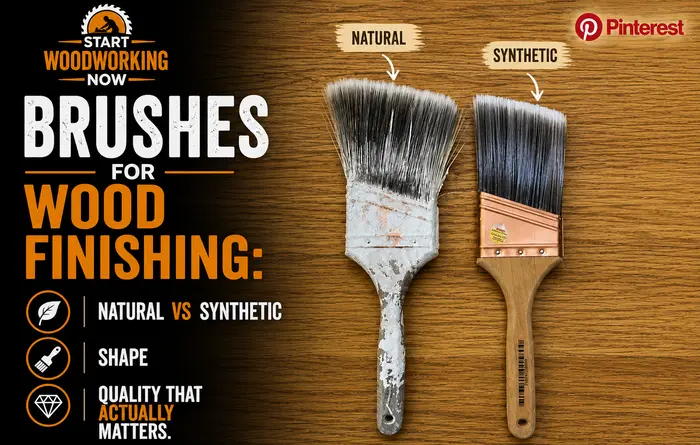
Brushes for Wood Finishing: Natural vs Synthetic, Shape, and Quality That Actually Matters
The natural-versus-synthetic bristle decision is chemistry, not preference — natural bristle is a protein structure that absorbs water and goes limp in water-based finish, while synthetic bristle doesn’t absorb water and holds its shape regardless of finish type. Most brush-buying advice states “use synthetic for water-based, natural for oil-based” as a rule to memorise without explaining why, which makes it easy to forget or misapply the first time a less common product — a water-based stain, a hybrid finish — doesn’t fit neatly into either category.
This article is part of the wood finishing guide — covering finish selection, application, troubleshooting, and the equipment that determines application quality.
Navigate to your question
→ Natural or synthetic bristle — which do I actually need? → The chemistry reason, not just a rule to memorise ↓
→ What brush shape do I need for my project? → Flat, angled, chip, and foam — by task ↓
→ What actually makes one brush better than another? → Flagging, ferrule construction, and the pull test ↓
→ How do I clean and store a brush so it lasts? → The correct solvent and routine by finish type ↓
→ What brush mistakes cause visible defects in the finish? → Shedding, overloading, and the wrong bristle for the job ↓
Natural vs Synthetic Bristle — The Chemistry Reason
Natural bristle — most commonly China bristle (hog hair) for general use, ox hair for fine detail brushes — is made of keratin, the same structural protein found in human hair and fingernails. Keratin is hygroscopic to a meaningful degree: it absorbs water from its surroundings and swells slightly as it does, a property that’s harmless and even useful in oil-based finishes (which contain no water) but becomes a genuine problem in water-based ones.
Why Natural Bristle Goes Limp in Water-Based Finish
When a natural bristle brush is loaded with a water-based finish, the bristles absorb water from the finish itself, swelling and softening throughout the soak. This swelling causes the bristles to lose the crisp snap and spring that makes a brush control finish flow predictably — the brush becomes soft, splays unpredictably under pressure, and loses its ability to lay down an even, controlled line of finish.
The same brush, after the water-based session, often doesn’t fully recover its original snap even once dry, because repeated swelling and drying cycles gradually degrade the bristle’s structural memory.
Synthetic bristle — nylon, polyester, or a blend of the two — is a manufactured polymer fibre that doesn’t absorb water in any meaningful way. A synthetic brush loaded with water-based finish retains essentially the same stiffness and snap it has dry, making it the correct choice for any water-based product regardless of brand or specific formulation.
This is true even for water-based products that behave somewhat like oil-based ones in working time or level of build — the deciding factor for bristle choice is the water content of the carrier, not the finish’s other characteristics.
Why Natural Bristle Still Matters for Oil-Based and Solvent-Based Finishes
Natural bristle isn’t simply a worse, outdated option replaced entirely by synthetic — for oil-based finishes, varnish, and shellac, natural bristle’s structure genuinely outperforms synthetic in several ways that matter for fine finishing work. Natural bristle has a more complex, slightly irregular surface texture at the microscopic level that holds and releases oil-based finish more evenly than the smoother, more uniform surface of synthetic fibre, contributing to smoother flow-out and fewer visible brush marks in oil-based and shellac work specifically.
This is part of why traditional shellac and French polish work, covered in the shellac application guide covering brush and pad technique, has historically relied on natural bristle brushes even as synthetic options have become widely available.
The Edge Case — Hybrid and Modern Water-Based Formulations
Some modern synthetic bristle blends are specifically engineered to mimic natural bristle’s finish-holding characteristics while retaining synthetic’s water resistance, marketed as suitable for both water- and oil-based work. These hybrid synthetic brushes are a reasonable single-brush solution for a shop using both finish types regularly, though dedicated natural bristle still edges out hybrid synthetic for the finest oil-based and shellac work where flow-out quality matters most.
Brush Shape — Flat, Angled, Chip, and Foam
Beyond bristle material, brush shape and construction determine how well a brush suits a specific task, and using the wrong shape for the job creates avoidable technique difficulty regardless of bristle quality.
Flat Brushes — General Purpose
A flat brush with square-cut bristles is the standard choice for flat panels, tabletops, and broad surfaces where straight, parallel strokes are the natural technique. Widths from 1.5 to 3 inches cover most furniture and cabinet work, with wider brushes suited to larger flat panels and narrower brushes offering more control on smaller pieces.
Angled Brushes — Edges, Corners, and Trim
An angled (sash) brush has bristles cut at a slant rather than square, which makes it considerably easier to control finish right up to an edge, into a corner, or along a line — such as cutting in around hardware, into a moulding profile, or along the edge where a panel meets a frame. The angled tip lets the brush follow a line with the brush body held at a comfortable angle rather than requiring an awkward wrist position to keep a flat brush’s straight edge aligned with the target line.
Chip Brushes — A Legitimate but Narrow Use Case
Chip brushes (inexpensive, disposable natural-bristle brushes, often sold in bulk) get inconsistent advice — some sources dismiss them entirely as unsuitable for finishing, others recommend them for everything because of the low cost. The accurate picture sits between these: chip brushes are genuinely useful for glue-up squeeze-out cleanup, for applying stain or a first wash coat that will be sanded back before the finish coats proper, or for any rough, non-critical application where bristle shedding and an imprecise edge don’t matter.
They are a poor choice for a fine furniture topcoat or any application where a smooth, even, defect-free final surface matters, because chip brush bristles are typically of inconsistent length and poorly retained in the ferrule, shedding loose bristles into the wet finish more readily than a quality brush.
Foam Brushes — Thin Coats, With Real Limitations
Foam brushes apply thin, even coats of shellac, polyurethane, or varnish with minimal brush-mark risk, since there are no individual bristles to leave lines, and they’re inexpensive enough to discard after use rather than clean.
Their real limitation is pressure sensitivity: pressing a foam brush firmly against the surface compresses the foam cell structure and can introduce air bubbles into the wet finish as the compressed foam releases, particularly noticeable in faster-drying finishes like shellac and lacquer where bubbles don’t have time to level out before the surface sets.
Foam brushes also shed small foam cell fragments into the finish more readily than people expect, especially as the brush degrades with reuse across multiple coats — using a fresh foam brush per coat or per session, rather than trying to extend one brush’s life, avoids this becoming a visible defect.
What Actually Determines Brush Quality
Price alone is an unreliable indicator of brush quality — some inexpensive brushes perform adequately for their intended use, and some expensive brushes are overbuilt for tasks that don’t need that level of refinement. Three specific construction details matter more than price.
Bristle Flagging
Flagging refers to the split, feathered tips on quality bristles — both natural and good synthetic bristle can be flagged — which increases the surface area at the tip of each bristle. This matters practically because flagged tips hold more finish per bristle and release it more gradually and evenly as the brush moves across the surface, contributing directly to smoother flow-out and fewer visible brush marks.
Unflagged, blunt-cut bristle tips (common on cheap, mass-produced brushes) hold less finish and release it less predictably, requiring more frequent reloading and producing a less even result for the same technique. Holding a brush up to good light and looking closely at the bristle tips — flagged tips show a visibly frayed, split structure rather than a clean blunt cut — is a quick way to assess this before purchase.
Ferrule Construction and Bristle Retention
The ferrule (the metal band securing the bristles to the handle) and the quality of the epoxy or adhesive bond within it determine how well a brush retains its bristles under use.
A poorly constructed ferrule sheds bristles into the wet finish during application — a genuinely common and frustrating problem with low-quality brushes, requiring the shed bristle to be picked out of curing finish before it sets, or sanded out afterward if missed.
The Pull Test
Before using a new brush for the first time — ideally before purchase, if handling the brush in person — grip a small section of bristles near the tip and pull gently but firmly. A well-constructed brush sheds at most one or two loose bristles from this test; a poorly constructed one sheds noticeably more, signalling a brush likely to shed into actual finishing work.
This single quick test catches most retention problems before they become a mid-coat frustration, and is worth doing even on brushes from a generally trusted brand, since manufacturing consistency varies even within a single product line.
Brush Care and Cleaning by Finish Type
Correct cleaning solvent matches the finish’s own thinner — using the wrong solvent either fails to remove the finish from the bristles or, in some cases, can affect the bristle material itself.
| Finish Type | Cleaning Solvent | Bristle Type |
|---|---|---|
| Oil-based polyurethane, varnish | Mineral spirits | Natural |
| Water-based polyurethane, stain | Warm water and mild soap | Synthetic |
| Shellac | Denatured alcohol | Natural |
| Lacquer | Lacquer thinner | Natural or solvent-resistant synthetic |
Clean immediately after use rather than letting finish begin to set in the bristles — once a finish has cured within the bristle cluster near the ferrule, no solvent reliably restores the brush, since the cured material is no longer soluble in its original solvent (the same thermoset chemistry covered in the polyurethane application guide applies to polyurethane cured inside a brush exactly as it does on a workpiece).
After cleaning, work a small amount of brush conditioner or a few drops of the appropriate oil into natural bristle before storage to help maintain its shape and prevent the bristles from drying out and becoming brittle over months of storage. Store brushes flat or hanging, never standing on their bristles, to prevent the bristles from bending or splaying out of shape under their own weight or the brush’s.
Common Brush Mistakes That Cause Visible Defects
Using Natural Bristle With Water-Based Finish
Beyond the loss of control covered above, a natural bristle brush used with water-based finish can shed swollen, weakened bristles more readily than it would in oil-based work, since the swelling itself further stresses the bristle’s bond at the ferrule. Switching to the correct synthetic brush for water-based work resolves both the control problem and this elevated shedding risk simultaneously.
Overloading the Brush
Dipping a brush too deep into the finish and failing to remove excess against the container’s rim before application deposits too much finish per stroke, increasing the risk of drips, runs, and uneven film thickness. The correct loading technique — dipping roughly a third of the bristle length and tapping or lightly dragging the brush against the inside rim to remove excess — is covered in the context of full brush application technique in the polyurethane application guide covering loading and wet-edge technique.
Using a Worn-Out or Poorly Maintained Brush on a Fine Topcoat
A brush that’s been used for years without proper cleaning and conditioning gradually loses bristle flagging quality, develops uneven bristle lengths from repeated improper cleaning, and may carry residual cured finish near the ferrule that flakes loose during use.
The brush marks that result get attributed to technique or to the product, when the actual cause is a brush no longer suited for fine work — a problem covered alongside other brush-stroke-specific defects in the polyurethane brush marks guide covering technique and equipment causes. Retiring a heavily used brush to rough work (glue cleanup, first coats that get sanded back) rather than continuing to use it for fine topcoats avoids this becoming a recurring, hard-to-diagnose source of defects.
Brush choice matters less than where you use it. A good brush in a dusty room produces a worse surface than a mediocre one in a clean space, which is why the finishing area gets planned before the tools get bought — see planning the finishing space.
Frequently Asked Questions
Can I use a synthetic brush for oil-based polyurethane?
Yes, synthetic bristle works fine with oil-based finishes and won’t be damaged by the solvent carrier. The main consideration is finish quality rather than compatibility: natural bristle’s microscopic surface texture tends to produce slightly smoother flow-out on oil-based and shellac work, so for the finest furniture topcoats, natural bristle still has a small edge, but synthetic is a perfectly functional choice if that’s what’s available.
How many times can I reuse a foam brush?
Foam brushes can technically be cleaned and reused, but they degrade with each use — the foam cell structure compresses and weakens, increasing both bubble risk and cell-fragment shedding into the finish on subsequent uses. Given their low cost, using a fresh foam brush per coat (or at minimum per finishing session) is the more reliable approach for fine work, reserving reuse for rough or non-critical applications.
My new brush is shedding bristles into my finish — is it defective?
A small number of loose bristles (one or two) on first use is normal even for a quality brush. Persistent or heavy shedding indicates poor ferrule construction or adhesive bonding — genuinely a quality issue, not something you’re doing wrong. Running the pull test described in this guide before first use catches this before it becomes a problem mid-coat; if a brush fails that test, it’s reasonable to return it or relegate it to rough work only.
Do I need different brushes for different sheen levels of the same finish?
No — sheen level (matte, satin, gloss) comes from flatting agent content in the formulation, not from anything that requires a different brush. The same brush appropriate for a given finish type and carrier (oil or water-based) works identically across that product’s full sheen range, since the underlying polymer and bristle-compatibility chemistry don’t change with sheen.